

How We Build Enterprise Software That Scales
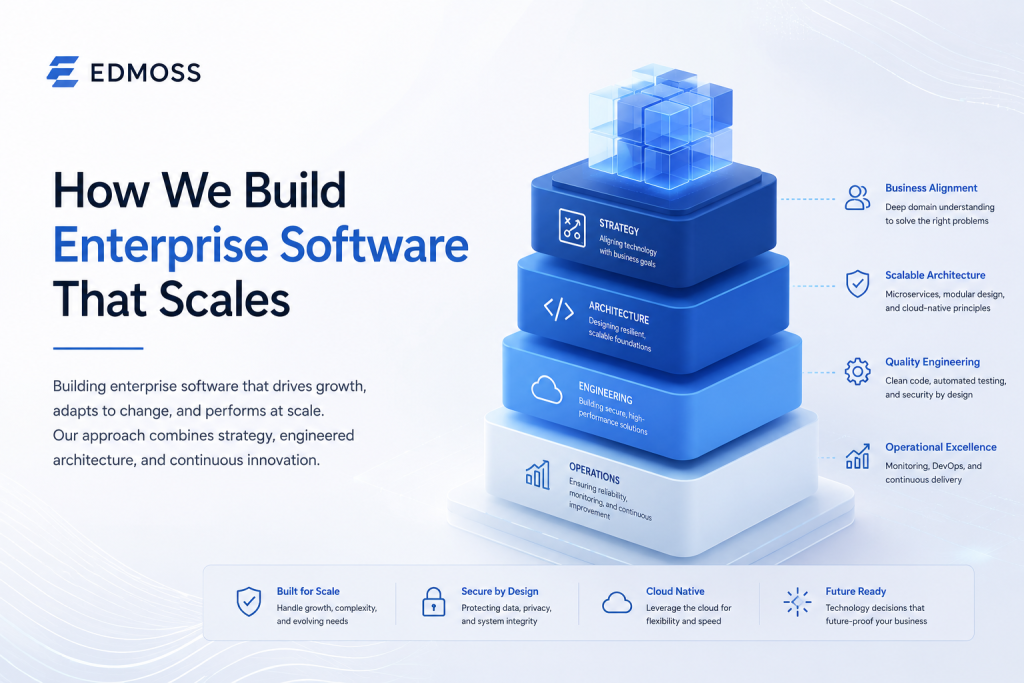
Building enterprise software isn’t just about writing code—it’s about designing systems that remain reliable, secure, and maintainable as your business grows.
As organizations expand, their software must support more users, larger datasets, additional integrations, and increasingly complex business processes. Many applications perform well during their first few months but begin to fail under the demands of real-world growth because scalability was never considered from the beginning.
At Edmoss, we approach enterprise software differently. Every solution is designed with long-term growth, security, and operational excellence in mind.
What Does “Scalable Software” Mean?
Scalable software is designed to accommodate business growth without requiring a complete rebuild. Whether your platform serves 100 users today or one million users in the future, the underlying architecture should evolve efficiently while maintaining performance, security, and reliability.
Scalability includes much more than handling traffic. It also means supporting new features, integrating with third-party services, maintaining data integrity, and enabling development teams to deliver updates quickly and safely.
Our Enterprise Development Approach
1. We Start With Business Goals
Technology should always support business objectives.
Before selecting a programming language or cloud platform, we work to understand:
- The business problem being solved
- Target users and customer journeys
- Existing operational challenges
- Growth expectations
- Compliance requirements
- Integration needs
- Success metrics
This discovery phase ensures every technical decision aligns with measurable business outcomes.
2. Designing the Right Architecture
One architecture does not fit every business.
Depending on project requirements, we evaluate approaches such as:
- Modular Monolith Architecture
- Microservices
- Event-Driven Systems
- API-First Platforms
- Serverless Services
- Cloud-Native Applications
Our goal is not to use the latest trend but to choose the architecture that provides the best balance between scalability, maintainability, development speed, and operational cost.
3. Security Is Built Into Every Layer
Enterprise applications manage valuable business data.
Security is considered throughout the development lifecycle rather than being treated as a final checklist.
Our development practices include:
- Secure authentication and authorization
- Role-based access control
- Data encryption
- API security
- Input validation
- Secure coding standards
- Regular dependency updates
- Environment isolation
- Audit logging
Building secure software protects both our clients and their customers.
4. Cloud-Ready Infrastructure
Modern software should be prepared for growth from day one.
We build systems that can run efficiently on leading cloud platforms while supporting:
- Automatic scaling
- High availability
- Backup and disaster recovery
- Load balancing
- Monitoring and alerting
- Infrastructure automation
Cloud-native development enables businesses to expand without significant infrastructure limitations.
5. API-First Development
Today’s businesses depend on connected systems.
Enterprise software often integrates with:
- Payment providers
- CRM platforms
- ERP systems
- HR solutions
- Accounting software
- Identity providers
- AI services
- Mobile applications
By designing APIs first, we ensure future integrations remain straightforward, secure, and maintainable.
6. Performance Matters
Users expect fast, responsive applications regardless of traffic volume.
Performance optimization is built into every stage of development through:
- Efficient database design
- Intelligent caching strategies
- Optimized queries
- Content delivery networks
- Background processing
- Asynchronous task execution
- Performance monitoring
Good performance improves both customer experience and operational efficiency.
7. Continuous Testing and Quality Assurance
Reliable software requires consistent validation.
Our quality assurance process combines:
- Automated testing
- Manual testing
- Functional testing
- Regression testing
- Performance testing
- Security testing
- User acceptance testing
Testing early and continuously reduces risk while improving release confidence.
8. Continuous Integration and Continuous Delivery
Modern development teams need efficient deployment pipelines.
We implement CI/CD practices that allow software updates to be released safely, consistently, and with minimal downtime.
Benefits include:
- Faster release cycles
- Reduced deployment risk
- Automated quality checks
- Easier rollback procedures
- Improved development collaboration
9. Monitoring Beyond Launch
Launching software is only the beginning.
After deployment, we continue monitoring:
- Application performance
- Error rates
- System availability
- Infrastructure health
- Security events
- User behavior
- Resource utilization
Operational insights help identify opportunities for optimization before problems affect users.
10. Planning for Future Growth
Every enterprise application should be built with tomorrow in mind.
Our systems are designed to support:
- New business units
- International expansion
- Additional integrations
- Mobile applications
- AI-powered automation
- Increased transaction volumes
- Growing development teams
Planning for growth from the beginning reduces technical debt and minimizes costly redesigns later.
Why Businesses Choose Edmoss
Successful enterprise software is not created by technology alone.
It requires a structured engineering process, clear communication, strong project governance, and a deep understanding of business operations.
At Edmoss, we combine modern software engineering practices with practical business thinking to deliver platforms that are secure, scalable, and built for long-term success.
Whether you’re building a new SaaS platform, modernizing legacy systems, developing AI-powered business applications, or creating enterprise digital products, our goal is the same:
Build software that continues to perform as your business grows.
Ready to Build Software That Scales?
If you’re planning your next enterprise platform, we’d be happy to discuss your goals, architecture, and growth strategy.
Let’s build software designed not just for launch—but for the future.
